 Pin It
 The first time I attempted these, I was standing in my kitchen at dawn on Fat Tuesday, frantically searching for something that felt festive enough to justify the holiday without requiring me to actually make croissants from scratch. My hands were covered in pecan dust, the butter was softening faster than I could work with it, and I suddenly realized that all I needed was a shortcut and a little boldness. Those store-bought croissants in my freezer weren't a compromise—they were an invitation to do something unexpected with them.
I made a batch of these for my neighbors on Mardi Gras morning, and something shifted the moment they bit into them—suddenly we weren't just neighbors exchanging baked goods, we were conspiring over a shared moment of indulgence before noon. One of them asked if I'd really made them, and instead of explaining the shortcut, I just smiled and offered her the icing-stained recipe card.
Ingredients
- Store-bought or bakery croissants (8 large, preferably day-old): Day-old croissants have set structure that won't fall apart when you slice them open, and they reheat beautifully in the oven—if you must use fresh, just be extra gentle and let them cool for an hour first.
- Pecan halves or pieces (1 cup): Toast them lightly in a dry skillet before pulsing if you want deeper flavor, though raw pecans work just fine and let the spices shine.
- Light brown sugar, packed (3/4 cup): The molasses content adds warmth and moisture to the filling, making it less likely to dry out during baking.
- Unsalted butter, softened (1/2 cup): Softening it to room temperature is non-negotiable—cold butter will chunk up and refuse to blend smoothly with the sugar.
- Large egg (1): This binds everything and adds lift, so don't skip it even if you're tempted to reduce ingredients.
- Ground cinnamon (1/2 tsp): This is where the King Cake spirit lives—don't hold back or substitute.
- Ground nutmeg (1/4 tsp): A quarter teaspoon is enough to whisper spice without overwhelming the pecans.
- Salt (1/4 tsp): Even in a sweet filling, salt amplifies all the other flavors and keeps everything from tasting one-dimensional.
- Vanilla extract (1/2 tsp): A small amount ties the whole filling together and adds complexity.
- Powdered sugar (1 cup): Sift it if you have lumps, otherwise your icing will be grainy and bitter-looking instead of glossy.
- Milk (2–3 tbsp): Start with 2 tablespoons and add more slowly—you want an icing that drips lazily, not pours.
- Vanilla extract (1/2 tsp): Same bottle as the filling, but this vanilla is tasted directly in the icing, so quality matters here.
- Purple, green, and gold sanding sugars: These are the heart of the presentation—don't use regular granulated sugar or the effect falls flat.
Tired of Takeout? 🥡
Get 10 meals you can make faster than delivery arrives. Seriously.
One email. No spam. Unsubscribe anytime.
Instructions
- Set your oven and workspace:
- Preheat to 350°F and line your baking sheet with parchment paper so nothing sticks and cleanup is minimal. This gives you a few minutes to organize while everything heats.
- Process the pecans:
- Pulse them in a food processor until they're finely chopped but still have some texture—you want tiny fragments, not pecan butter, or the filling becomes dense and gummy. Stop as soon as they look like coarse sand.
- Cream the butter and sugar:
- In a mixing bowl, beat them together for about 2 minutes until the mixture looks pale and fluffy, like soft clouds. This incorporates air and lightens the texture of the finished filling.
- Build the filling:
- Add the egg and beat until it disappears completely into the mixture, then add the cinnamon, nutmeg, salt, and vanilla, stirring until fragrant. Fold in the chopped pecans last and stir until everything is evenly distributed with no streaks of unmixed butter.
- Prepare the croissants for stuffing:
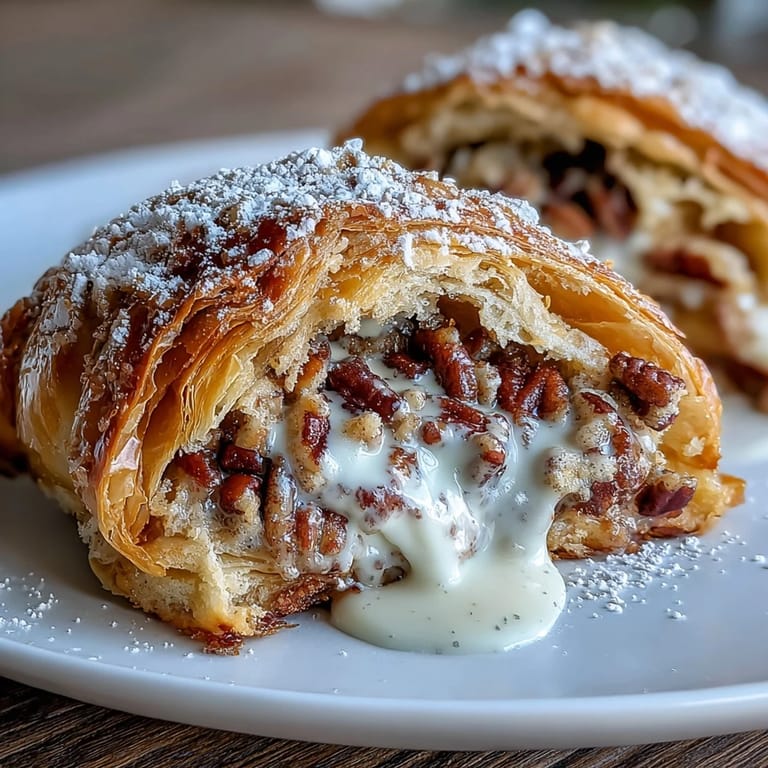
- Using a sharp serrated knife, gently split each croissant horizontally as if you're opening a book, but leave about an inch of the back uncut so it stays hinged. This takes a light touch—sawing aggressively will crush the layers.
- Fill and close:
- Spread about 2 tablespoons of the pecan filling evenly inside each croissant, then gently press the top closed so the filling stays inside during baking. Don't overstuff or it will squeeze out and burn on the pan.
- Bake until golden:
- Place the stuffed croissants on your prepared baking sheet and bake for 12–15 minutes, until the exterior is deep golden and the filling feels set when you gently press the side. The kitchen will smell impossibly good at this point.
- Make the icing while they bake:
- Whisk powdered sugar, milk, and vanilla together in a bowl until it reaches a consistency that drips from a whisk in ribbons but holds a line. If it's too thick, add milk by the half-teaspoon; if it's too thin, add more powdered sugar slowly.
- Finish with festive flair:
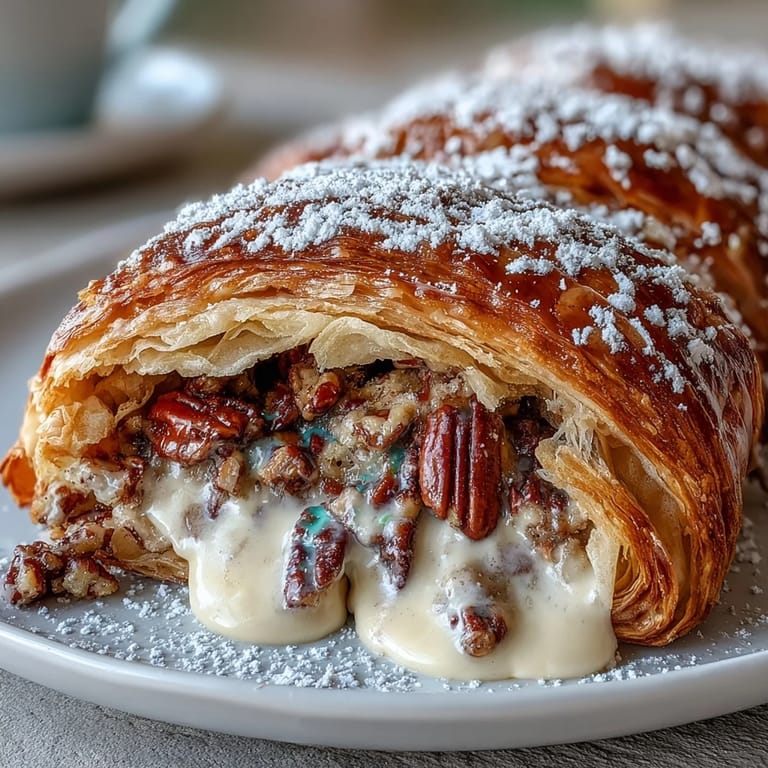
- Let the croissants cool just until you can handle them without burning your fingers (about 3–5 minutes), then drizzle the icing over each one in thin lines. Immediately sprinkle the purple, green, and gold sugars in stripes while the icing is still wet so they stick.
- Serve with purpose:
- Eat them warm or at room temperature—they're stunning either way, and the flavors actually deepen slightly as they cool.
 Pin It
My partner walked into the kitchen while these were cooling and asked if I'd made them from scratch, and I realized in that moment that the magic isn't in whether you made every component yourself—it's in the care you took to transform something simple into something that feels celebratory. That's when food stops being sustenance and becomes a love language.
Why Day-Old Croissants Are Your Secret Weapon
Fresh croissants look gorgeous but they're also fragile—their layers haven't had time to set and stabilize. A day-old croissant, by contrast, has developed a structure that can handle slicing, stuffing, and reheating without collapsing into a pile of buttery regret. The dry oven heat actually wakes them back up, crisping the exterior while the pecan filling steams the interior back to tenderness. It's the culinary equivalent of a second chance, and it works beautifully.
The Icing Technique That Changes Everything
The difference between icing that looks homemade and icing that looks professionally applied is the temperature at which you apply it and how quickly you add the sanding sugar. If the icing is still warm when it hits the croissant, it seeps into the exterior and gets absorbed; if it's cool and thin, it sits on top and creates a glossy shell. The sanding sugar needs to stick to that wet icing before it dries, so work in sections and sprinkle immediately—hesitation shows.
Make-Ahead Magic and Storage
These croissants are at their absolute best on the day they're made, but there are ways to work with your schedule. You can assemble them unbaked, cover them loosely with plastic wrap, and refrigerate overnight—the filling actually firms up and distributes more evenly this way, making them easier to handle in the oven. Once baked and decorated, they stay fresh at room temperature in an airtight container for about 24 hours, though by day two the croissant exterior loses its crispness and becomes more cake-like, which isn't necessarily bad, just different.
- If you're entertaining, bake them about 20 minutes before guests arrive so they're still warm and fragrant when served.
- Reheat leftovers uncovered in a 300°F oven for 5 minutes to restore the croissant's crispness without drying out the filling.
- The icing can be made up to 4 hours ahead and stirred vigorously before using if it thickens slightly from sitting.
 Pin It
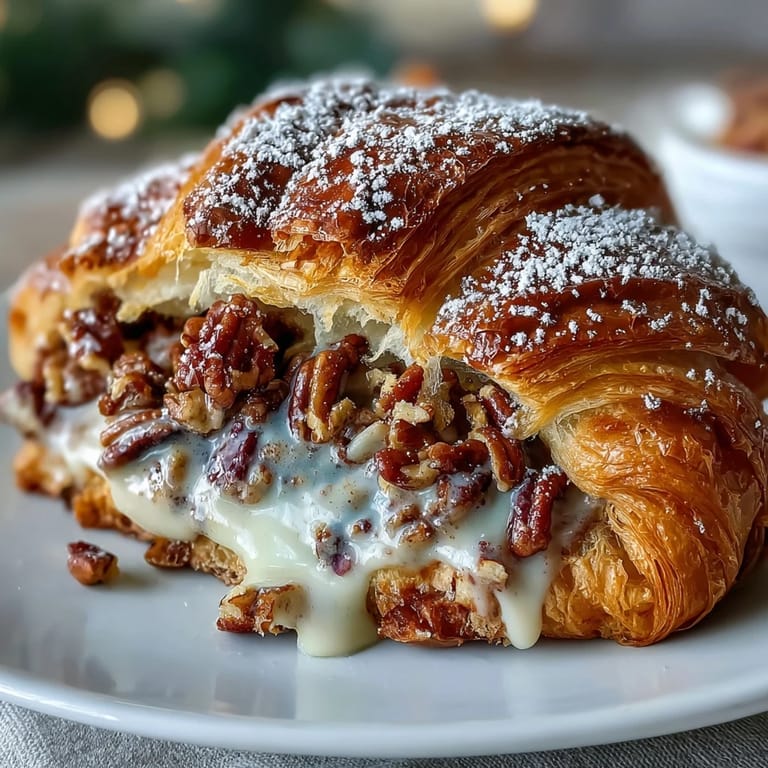
 These croissants are the kind of recipe that reminds you why we bake at all—they're a celebration in pastry form, proof that sometimes the best parties are the ones you throw in your own kitchen. Make them when you need to feel festive, when you want to impress someone, or simply when you deserve something beautiful on a Tuesday morning.
Recipe Questions & Answers
- → What type of pecans work best for the filling?
Use pecan halves or pieces to maintain texture in the filling without creating a paste.
- → Can I use store-bought croissants for this dish?
Day-old store-bought or bakery croissants are preferred for best texture and ease of stuffing.
- → How should the croissants be prepared before baking?
Split each croissant horizontally with a hinge, fill with pecan mixture, then gently close before baking.
- → What gives the filling its spiced flavor?
Cinnamon, nutmeg, vanilla, and a touch of salt combine with butter and brown sugar to create a warm, spiced profile.
- → How is the decorative icing made?
Whisk powdered sugar, milk, and vanilla until smooth and pourable, then drizzle over warm croissants before sprinkling colored sugars.
- → Can these be prepared ahead of time?
Yes, assemble and refrigerate the unbaked croissants overnight, then bake when ready to serve.